
October 21, 2026
Clinical trial enrollment projections are a critical component of study planning. Sponsors depend on these forecasts to determine key operational assumptions, including the number of sites required, study duration, resource allocation, and overall trial costs.
Despite their importance, enrollment remains one of the most difficult aspects of clinical research to predict accurately. Many studies experience enrollment rates that fall short of projections, while some activated sites fail to enroll participants altogether.
Why does this happen?
The reality is that enrollment projections are often developed before all of the variables influencing recruitment are fully understood. As studies progress from concept to execution, numerous factors can affect actual enrollment performance.
For example, a final protocol may introduce eligibility requirements that were not known when sites were provided initial information for enrollment estimates; site staff may be stretched thin across multiple studies and unable to dedicate the time and effort to screening that they initially anticipated; despite best efforts from the study team, participants may unexpectedly find the study too burdensome or decide participation is simply not right for them; competing studies, changes in the standard of care, and other market conditions can also affect the available patient population and their willingness to participate in research.
Consider a common oncology example. A site may originally estimate that it can enroll two patients per month based on historical patient volume. However, if a competing study opens in the same indication or a newly approved therapy becomes available during startup, many of those patients may no longer be eligible or interested in participation. Suddenly, enrollment projections built on historical assumptions no longer reflect current realities.

Perhaps the most important consideration is the fact that every single trial is unique – no study has been run exactly like yours before, and that makes predicting accurate enrollment rates complicated.
The goal of a thoughtful feasibility process is to factor in these variables (and others) to reduce as much avoidable uncertainty as possible and to develop an enrollment estimate that is realistic enough to plan around.
Developing A Repeatable Process for Predicting Clinical Trial Enrollment
Accurate enrollment forecasting requires a systematic approach that progressively narrows the pool of potentially eligible participants based on study, site, and patient-specific factors.
Rather than relying on a universal enrollment formula, the best enrollment projections are thoughtfully crafted for each individual study, backed by experience and data and with consideration of patient and site realities.
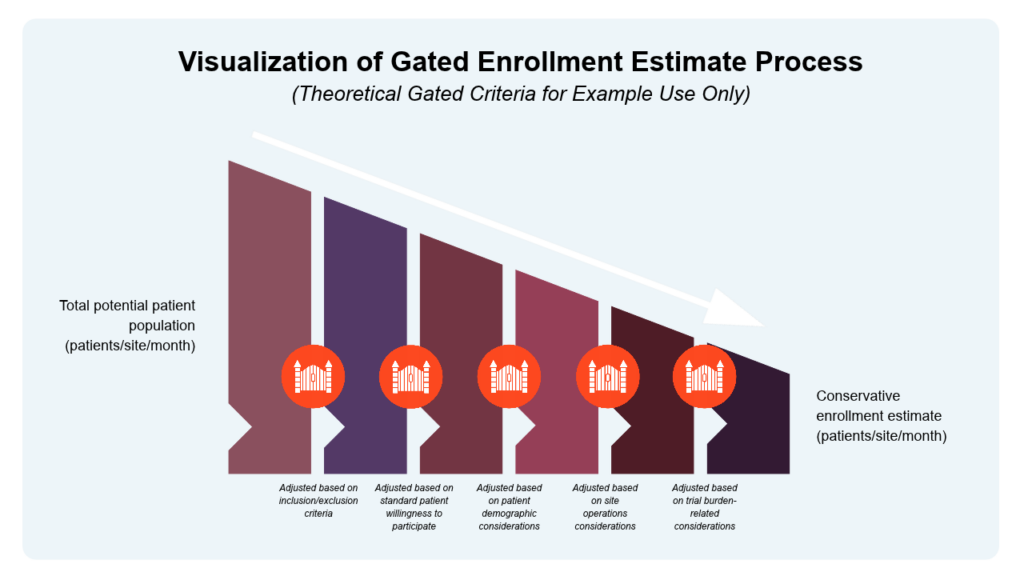
This approach can be visualized as a series of gates, each representing a factor that may further narrow the pool of participants who are realistically available for enrollment.
For example:
A population of 10,000 may initially meet the disease criteria.
Only a subset may satisfy the protocol’s inclusion and exclusion requirements.
Of those, only some may be treated at participating sites.
A percentage will decline participation when approached.
Others may fail at screening.
A Closer Look at the Gated Approach for Clinical Trial Enrollment Prediction
At PharPoint, enrollment assessment begins with gathering and evaluating data from multiple sources to develop conservative, evidence-based projections. While important, we recognize that data alone cannot provide the full picture, and that complementary insights from an experienced team can be invaluable for both accurate predictions as well as strategies for improving enrollment potential overall.
Each consideration in an enrollment assessment should draw on the best available evidence for the study. Sources may include published research, real-world data, site-reported information, historical enrollment performance, knowledge of the disease and patient population, and insight into site operations.
Published or commercially available research can sometimes provide specific data points, such as the percentage of a patient population willing to enroll in a clinical trial when offered the opportunity. However, such data may be incomplete, outdated as standards of care evolve, or unavailable altogether. When the evidence is limited, deep industry experience and practical knowledge become particularly valuable.
A feasibility team must be able to identify seemingly minor protocol details that could influence recruitment and evaluate how a potential site’s staffing, patient access, and processes may affect its ability to convert potential participants into enrolled participants.
In parallel, PharPoint evaluates the broader market landscape to identify sites and regions with stronger access to the target patient population. This often involves analyzing real-world sources such as payer and claims data to better understand where patients with specific diagnoses are concentrated geographically.
This layer of analysis helps us pinpoint sites who may have greater access to the population needed for enrollment, but is not looked at alone. For example, a site may operate in a region with a large concentration of the target population, but have limited capacity to recruit those patients. Another site may operate in a smaller market but have strong relationships with the relevant patient population.
Combining this market-level information with site-specific intelligence provides a more complete view of enrollment potential for sponsors.
Enrollment Potential and Overall Protocol Feasibility
Enrollment forecasting should not occur in isolation from protocol development.
The most successful feasibility efforts involve close collaboration between feasibility specialists, operational experts, medical personnel, and sponsors to evaluate how protocol decisions may influence recruitment outcomes.
Feasibility teams can provide patient- and site-centric perspectives, and when appropriate, can challenge protocol details that may significantly increase burden and slow enrollment.
The conversation should go beyond:
“We have identified sites that can support this study.”
It should also include:
“We identified sites that can support this study, but we’ve also identified protocol elements that may limit enrollment. By adjusting these areas, we believe recruitment can be accelerated and enrollment risk reduced.”
That difference reflects the transition from simply executing a study to actively improving its likelihood of success.
At PharPoint, enrollment forecasting is not simply a startup exercise. It is a discipline grounded in decades of collective experience across therapeutic areas, study phases, and patient populations. Our feasibility, operations, clinical, and data experts have developed enrollment projections for studies ranging from highly competitive indications to rare disease programs where every participant matters. By combining rigorous data analysis with practical operational insight, we provide sponsors with realistic enrollment estimates that can withstand scrutiny from internal stakeholders, investors, and study teams alike. More importantly, our projections are informed by actual trial performance and lessons learned from studies we’ve helped deliver, allowing us to identify enrollment risks early and develop mitigation strategies before they impact timelines.
Conclusion
Predicting enrollment will never be an exact science, but it should never be guesswork. The most successful studies are built on realistic assumptions, thoughtful planning, and a clear understanding of the factors that influence recruitment success. By combining data, operational expertise, site intelligence, and practical feasibility insights, sponsors can make more informed decisions and reduce avoidable enrollment risk.
If you’re evaluating enrollment assumptions for an upcoming study, developing a feasibility strategy, or simply looking for a second opinion on your recruitment projections, I’d welcome the opportunity to connect. Sometimes a fresh perspective and an experienced feasibility team can make the difference between optimistic projections and achievable enrollment goals.
RELATED RESOURCES

Navigating Complexity in Pulmonary Trials: Biomarker-Driven Approaches
Exec. Director of Strategy Paul Johnson discusses biomarker-driven approaches for complex pulmonary trials ...

Navigating Complexity in Pulmonary Trials: Enrichment Strategies
PharPoint's Exec. Dir. of Strategy Paul Johnson discusses the use of enrichment strategies in complex pulmonary trials ...

Navigating Complexity in Pulmonary Trials: Using Adaptive Trial Designs
PharPoint's Exec. Dir. of Strategy Paul Johnson discusses the use of adaptive trial design for complex pulmonary trials ...

Clinical Trial Activity in Japan and Taiwan (2015-2025): Trends and Phase Distribution
A look at a decade of Phase 1-4 studies in Japan and Taiwan, from 2015 to 2025 according to ClinicalTrial.Gov ...

Effective Site Feasibility: It all Starts with a Protocol and a Question(naire)
Learn what goes into an effective site feasibility questionnaire and how an experienced consultant can help inform your strategy ...

Phase 1 CRO Project Management: Avoiding Delays
Thorough planning is especially critical for Phase 1 trials, as even minor delays can cause major downstream effects ...