INTERACTIVE TOOL – SELF-GUIDED – FREE

ICH E8(R1) calls for creating a “Culture of Quality”
This entails creating a culture that “values and rewards critical thinking and open, proactive dialogue about what is critical to quality for a particular study or development programme, going beyond sole reliance on tools and checklists.”
Leaders that consistently advocate for a quality mindset
Teams that shift away from endless firefighting towards long-term solutions and proactive planning
Study team members who are not afraid to ask “why” and who are empowered to speak up about risks and improvement without fear of pushback or retribution
Visible metrics that meaningfully tell the story of the work being done

REFLECTING ON YOUR ORGANIZATIONS CULTURE OF QUALITY
Exploring the Seven Dimensions Evaluated in the Quality Maturity Assessment
Organizations that consistently achieve quality outcomes typically demonstrate strength across multiple areas, including leadership, processes, people, oversight, and continuous improvement.
The Quality Maturity Assessment evaluates seven dimensions that collectively influence quality performance across the organization.

1
Leadership and Governance
This dimension evaluates whether leadership actively supports quality initiatives, communicates clear expectations, and provides the governance structures necessary to sustain quality throughout the organization.
What assessment areas are included in this dimension?
- Quality vision and strategy
- Leadership commitment
- Governance structures
What does a high-scoring organization in this dimension look like?
Organizations with high scores in this area demonstrate strong executive engagement, leadership that inspires, and clear alignment between business objectives and quality goals.
2
Quality Systems and Processes
This dimension evaluates the effectiveness of the systems and processes used to manage quality activities across an organization.
What assessment areas are included in this dimension?
- SOPs and documentation
- Risk management
- Deviation and CAPA management
What does a high-scoring organization in this dimension look like?
Organizations with high scores in this area are able to work systematically to address the root cause of issues. Their processes are continuously monitored and improved according to feedback.


3
People and Capability
This dimension evaluates whether personnel possess the knowledge, skills, accountability, and support needed to use critical thinking that allows them to make quality-focused decisions.
What assessment areas are included in this dimension?
- Training and competency
- Quality ownership and mindset
- Employee empowerment and engagement
What does a high-scoring organization in this dimension look like?
Organization with strong scores in this area foster an overall culture where quality is viewed as everyone’s responsibility rather than the responsibility of a single department or QA team.
4
Operational Excellence and Continuous Improvement
This dimension examines how effectively organizations measure performance, identify opportunities for improvement, and apply lessons learned.
What assessment areas are included in this dimension?
- Process optimization
- Quality metrics and KPIs
- Feedback loops and organizational learning
What does a high-scoring organization in this dimension look like?
Strong performance in this area indicate an organization’s ability to adapt, improve, and prevent recurring issues. In these organizations, leadership are trained on data-driven approaches to continuous improvement and have developed meaningful, role-relevant metrics that are tracked and applied to decision-making.


5
Quality by Design (QbD) and Proactive Quality
This dimension evaluates whether quality considerations are integrated into planning and processes.
What assessment areas are included in this dimension?
- Early quality integration
- Cross-functional collaboration
- Preventative versus reactive quality practices
What does a high-scoring organization in this dimension look like?
Organizations with mature quality programs have fully adopted a Quality By Design (QbD) approach, and are able to focus on identifying and addressing risks before they affect study execution. These teams have shifted their organizational focus from reactive issue resolution to proactive prevention through risk anticipation, early detection, and process controls.
6
Technology and Innovation
This dimension evaluates how effectively organization leverage technology and analytics to improve quality performance.
What assessment areas are included in this dimension?
- Digital quality tools
- Data integrity and analytics
- Innovation culture
What does a high-scoring organization in this dimension look like?
Organizations scoring highly in this dimension collect and analyze data-driven quality insights to identify trends and inform strategic quality initiatives. Technology is used to streamline workflows and enhance visibility, and teams actively seek out and embrace new technologies and ideas that can enhance quality practices and outcomes.


7
External Partnerships and Oversight
This dimension assesses how oversight is used to maintain quality throughout the clinical trial ecosystem, supporting a team and greater vendor partnerships that are always inspection-ready.
What assessment areas are included in this dimension?
- Vendor quality management
- Audit and inspection readiness
- Transparency and trust
What does a high-scoring organization in this dimension look like?
High scorers in this dimension have established robust vendor qualification and oversight programs with metrics that matter. This includes meaningful conversations with vendors and stakeholders and the establishment of key risk indicators (KRIs) that match expectations to deliverables.
How the Assessment Works
PharPoint’s Quality Maturity Assessment is designed as a self-reflection tool. It provides a common framework organizations can use to understand their current state, identify areas of developing maturity, and prioritize improvements that strengthen proactive, risk-based approaches to quality.
Step 1: Answer 21 Questions
Use the Maturity Assessment to complete 21 questions covering the seven dimensions of quality maturity highlighted above. Each question is scored on a scale from 0 to 4 depending on your candid assessment of the current state of your organization.
Step 2: Review Your Quality Maturity Results
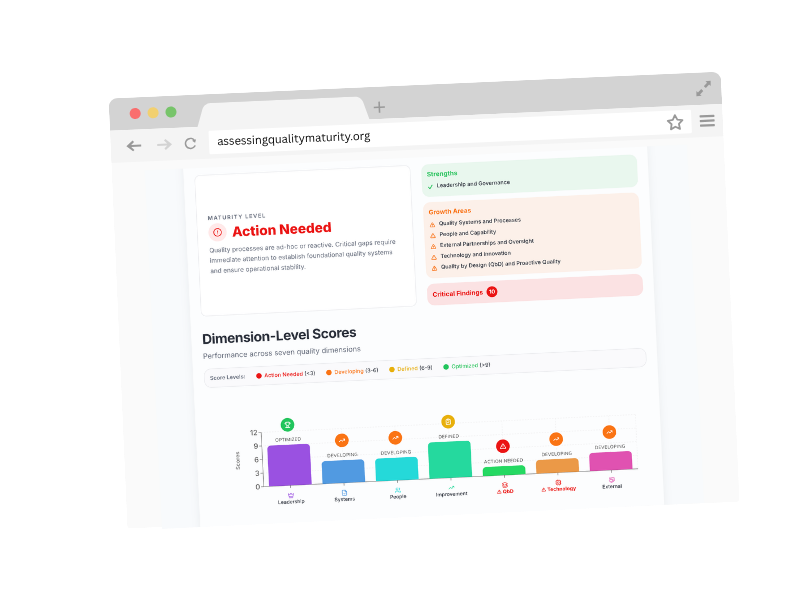
Once the assessment is complete, participants receive a visual summary of their results. Note that these results are not saved in any database, and closing your browser will delete all information.
Your summary of results will present your overall maturity level and display any notable strengths, growth areas, or critical findings.
As applicable, results will also provide brief information regarding next steps that your organization may pursue based on assessment findings. These can be used as starting points to inform ongoing quality discussions within your organization.
Step 3: Continuous Improvement
Consider recording your results and revisiting the assessment periodically to help gage progress over time and support continuous improvement.

Frequently Asked Questions
No. The assessment is intended as a self-evaluation tool, not an audit, inspection, or performance evaluation. It provides a common framework organizations can use to understand their current state, identify areas of developing maturity, and prioritize improvements that strengthen proactive, risk-based approaches to quality.
Most users complete this assessment in <10 minutes.
The Clinical Research Quality Maturity Assessment was designed primarily for biotechnology, pharmaceutical, and medical device companies seeking to evaluate and strengthen their approach to quality management.
The assessment may also be valuable for other organizations involved in clinical research and drug development.
Anyone may take this assessment, although quality professionals, clinical operations leaders, executive leadership, and team members involved in quality initiatives may find it most useful. More broadly, the assessment is intended for anyone interested in supporting quality discussions and advancing a culture of continuous improvement within their organization.
This assessment is intended to serve as a starting point for discussion and improvement. After reviewing your results, we recommend taking time to reflect on both your organization’s strengths and any areas identified for improvement. Consider how the findings align with ongoing qualities initiatives, organizational goals, and opportunities for continuous improvement.
Please note that assessment results are not stored or saved by PharPoint Research. If you would like to retain your results for future reference, we recommend taking screenshots or otherwise documenting the information before leaving the page.
Organizations may also find value in revisiting the assessment periodically to evaluate progress over time and measure the impact of improvement efforts.
If you would like additional support in developing an action plan, PharPoint’s quality consultants are available to discuss your organization’s specific needs and goals.
No.
The Clinical Research Quality Maturity Assessment was intentionally designed to operate as a private self-assessment tool. PharPoint does not collect, store, transmit, or analyze your responses.
Your answers and results remain within your browser session and are not sent to any PharPoint database – not even in an anonymized format.
Because this information is not stored, your results will be lost if you close or refresh the page. If you would like to keep a record of your assessment, we recommend saving screenshots or documenting your results before leaving the site.
Your assessment is yours alone and offered in the spirit of transparency and collaboration.