NOTE: This article was originally published as part of our PharPoint of View LinkedIn newsletter. Each month, our PharPOV series shares perspectives from across the PharPoint team: operational insights, trending topics, and stories about the behind-the-scenes collaboration that keeps studies moving. This article shares the perspective of Jayme Swinson, PharPoint’s Vice President of Operations.
June 2, 2026
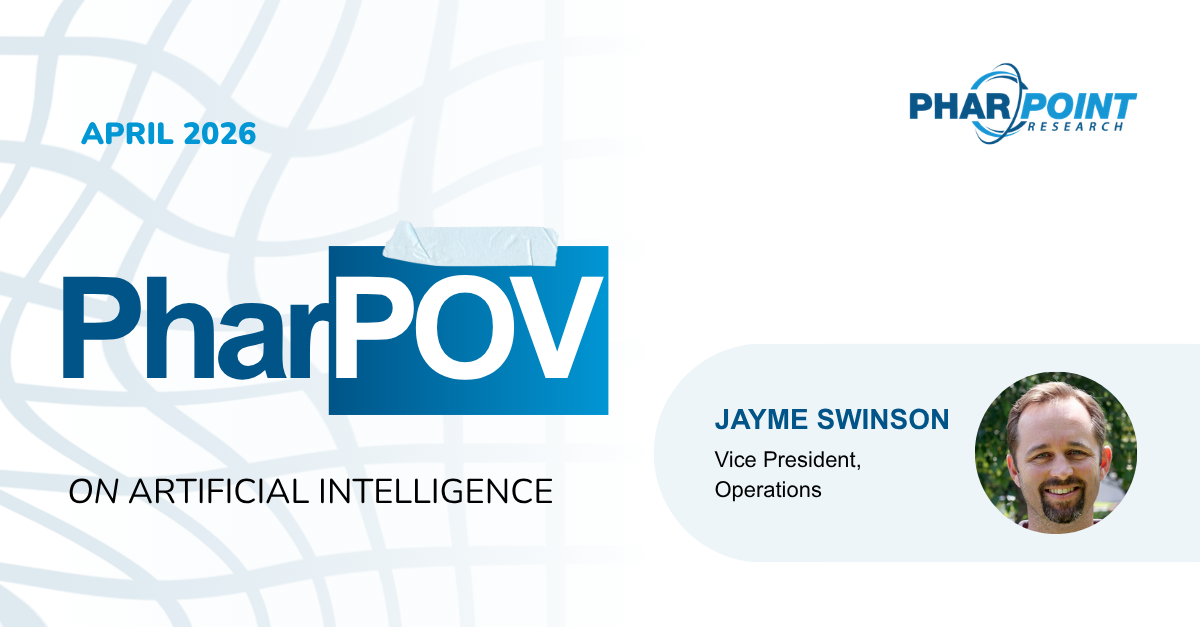
AI in Clinical Research
It’s no secret that Artificial Intelligence (AI) is revolutionizing the world of technology.
In clinical research it’s being leveraged in many ways such as to enhance trial designs, improve patient recruitment, and expedite data analysis just to name a few. As PharPoint partners with biopharmaceutical and device companies, we push to streamline workflows, accelerate timelines, reduce costs, and bring new therapies to market more efficiently with a passion to improve world health as the primary motivation for everything we do.
Despite the benefits of rapidly advancing technology, the adoption of AI in clinical research comes with challenges. Challenges for large language models (LLMs) used in AI include their inability to reproduce standard results over time and related concerns over unknown mechanisms of action and revisions to those mechanisms that produce a variable “black box” technology environment which does not always produce reliable and repeatable results. These challenges are known risks for unwarranted bias and AI hallucinations.
It is clear why the use of LLMs can easily represent a risk to regulatory compliance despite broadly written regulations and guidance from global regulatory agencies attempting to leave room for the innovative technology to be leveraged.
To accelerate innovation while maintaining regulatory compliance, organizations should establish policies and guidelines, thereby ring-fencing AI within their ability to govern and validate all output. An essential aspect of such policies and guidelines is to add a “human-in-the-loop” who is qualified to ensure the final product meets GxP requirements, results are accurate, and the safety of trial participants isn’t jeopardized.
Another area of key concern is data security. It is crucial that research organizations maintain the protection of data privacy, as sensitive patient data as well as corporate confidential information is processed by complex algorithms that may be vulnerable to data breaches. To mitigate these risks, PharPoint has established and continues to enhance our data governance practices to protect patient privacy and maintain compliance with client contracts in addition to regulations like HIPAA and GDPR.
As AI continues to gain momentum and become integrated into many of the systems we use, accelerating our processes and enhancing our services, PharPoint remains committed to leveraging technological advancements in ethical and responsible ways.
We firmly believe that AI holds tremendous promise for enhancing clinical research, but its adoption must be approached thoughtfully. Addressing concerns around privacy, bias, and regulatory compliance is critical to harnessing AI’s potential while safeguarding patient interests and maintaining the integrity of scientific discovery.

About the Author
Jayme Swinson, Vice President of Operations
Jayme Swinson, MS, Vice President of Operations at PharPoint, has over 25 years of experience within clinical research.
Jayme has worked at various contract research organizations with a focus within statistical programming. He joined PharPoint in 2007 as one of the company’s first employees, playing a key role in establishing the statistical programming department.
In his current role, Jayme oversees Data Management, Database Programming, and Clinical Operations and supports governance-level client relationships.
He has worked across multiple therapeutic areas and has been published in Obstetrics & Gynecology. Jayme holds an MS in Mathematics from the University of North Carolina at Wilmington, where his thesis focused on models of screening for HIV transmission.
RELATED RESOURCES
Assessing Quality Culture | PharPOV Series
How mature is your organization’s quality culture? Hear from PharPoint's Director of Quality Assurance.
Navigating Complexity in Pulmonary Trials | PharPOV Series
Exec. Dir. Strategy Development Paul Johnson kicks off the first article in a series on pulmonary trial design.
AI in Clinical Research | PharPOV Series
How can we make sure artificial intelligence (AI) is used ethically and responsibly in clinical research? Hear from PharPoint's VP of Operations.

When Customer Service Isn’t Enough | PharPOV Series
PharPoint's Exec. Director of Client Experience explains where customer service can fall short, based on conversations after a recent move.

Research is Personal | Video
Clinical trials are both scientific and deeply personal. This short video reflects the perspective that guides our work in supporting sponsors and patients.

Exploring Multiple Perspectives in Rare Disease Trials
What makes rare disease trials unique? Explore perspectives across functions from a rare disease CRO team.